
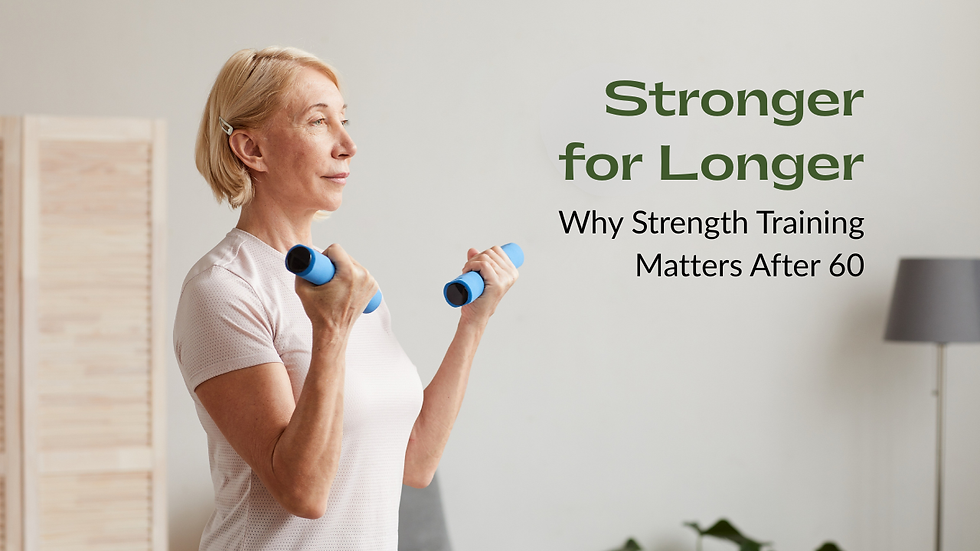
Stronger for Longer: Why Strength Training Matters After 60

Most people understand that staying physically active is an important part of healthy aging. Whether it's taking daily walks, tending to a garden, swimming laps at the community pool, or stretching to stay flexible, regular movement helps support both physical and mental well-being.
But while any movement is better than none, not all forms of exercise provide the same benefits.
If there's one type of exercise that health experts consistently recommend as we grow older, it's strength training, also known as resistance training. Unlike activities that primarily improve cardiovascular fitness, strength training challenges your muscles to work against resistance. That resistance may come from your own body weight, resistance bands, free weights, medicine balls, or weight machines.
The goal isn't to become a bodybuilder. It's to maintain the strength needed to continue doing the everyday activities that allow you to live independently and confidently.
Why Strength Matters More With Age
Beginning around age 30, adults gradually lose muscle mass as part of the natural aging process. Without regular resistance training, that loss accelerates over time, making everyday tasks more difficult than they once were.
Getting out of a chair. Carrying groceries. Walking up stairs. Lifting a grandchild. Even recovering from a stumble all depend on muscle strength.
According to the National Institute on Aging (NIA), approximately 30% of adults over the age of 70 experience difficulty with everyday mobility, including walking, climbing stairs, and rising from a seated position.
These changes affect more than convenience—they can also increase the risk of falls.
Falls remain one of the leading causes of injury among older adults, and recovery often becomes more difficult with age. Strong muscles improve balance, stability, and coordination, helping the body react more effectively when you trip or lose your footing. In many cases, maintaining strength can mean the difference between regaining your balance and experiencing a serious injury.
Perhaps just as importantly, stronger muscles help preserve independence. The ability to confidently move around your home, perform household tasks, and participate in the activities you enjoy contributes to both physical health and overall quality of life.
Research shows that strength training can reduce the risk of falls by improving muscle strength, balance, and physical function—three key factors that help adults maintain stability and independence.
More Than Muscles: The Connection to Bone Health
Strength training doesn't only benefit your muscles—it also plays an important role in maintaining healthy bones.
As we age, our bones naturally become less dense. For women, this process speeds up significantly after menopause. According to the Bone Health & Osteoporosis Foundation, adults over age 50 begin losing bone faster than they can replace it, and women may lose up to 20% of their bone mineral density during the first seven years after menopause.
Resistance training places healthy stress on the bones, signaling the body to maintain and even strengthen bone tissue. Combined with adequate calcium, vitamin D, and a balanced diet, regular strength training can help slow age-related bone loss and support long-term skeletal health.

The Research Is Clear
The benefits of strength training extend far beyond building muscle.
A 2026 systematic review and meta-analysis published in Frontiers in Public Health analyzed research involving older women living with sarcopenia, the age-related loss of muscle mass and strength. Researchers found that performing resistance training at least twice per week significantly improved muscle strength, walking speed, and overall physical function. Improvements in gait speed and lower-body strength are especially important because they directly influence mobility and the ability to perform everyday tasks safely.
Another study included in the review found that resistance training performed three times per week for eight to twelve weeks significantly improved hand grip strength and knee extension—two measures closely associated with independence, balance, and daily function.
Together, the findings reinforce what researchers have known for years: it's never too late to benefit from strength training, and even modest improvements in strength can have meaningful effects on everyday life.
Source: Zhou Y., Wen K., Zhang X., & Sun Y. (2026). "Effects of resistance training on muscle mass, strength, and physical function in older women with sarcopenia: A systematic review and meta-analysis." Frontiers in Public Health, 13, 1735899.
Finding the Right Type of Resistance
One of the biggest misconceptions about strength training is that it requires a gym membership or heavy barbells.
In reality, resistance simply means asking your muscles to work against a force. There are several ways to do that, and each can be adapted to your comfort level and abilities.
Bodyweight exercises use your own weight as resistance and are often a great place for beginners to start.
Resistance bands provide gentle, adjustable tension while placing less stress on the joints.
Dumbbells and free weights allow you to gradually increase resistance as your strength improves.
Medicine balls can be incorporated into functional movements that build coordination and core strength.
Weight machines offer guided movement patterns that some people find helpful, particularly when learning proper technique.
There's no single "best" method. The most effective approach is the one that's appropriate for your current fitness level, feels safe, and can be performed consistently.

Starting Safely
If you've never participated in strength training—or it's been several years since you have—it's perfectly okay to start slowly.
Before beginning any new exercise program, especially if you have existing health conditions or concerns, talk with your healthcare provider about what type of activity is appropriate for you.
Rather than focusing on how much weight you can lift, focus first on learning proper movement and technique. Good form helps reduce the risk of injury and creates a stronger foundation as you gradually progress.
Remember that strength isn't built overnight. Small, consistent efforts over time often produce better long-term results than doing too much, too soon.
As Eric Shiroma, Sc.D., a scientist with the National Institute on Aging, has noted through his research on exercise and aging, physical activity doesn't have to be extreme to be effective. Even adding a little extra challenge to everyday movement—such as walking with a weighted backpack or vest, a practice known as rucking—can help build strength over time. He also emphasizes that aging affects everyone differently, which is why finding activities that match your individual abilities and goals is so important.
You don't have to lift the heaviest weights in the gym or train like a competitive athlete to experience the benefits of strength training. Building and maintaining strength is simply about giving your body the support it needs to continue doing the things you love—for years to come.

By, Lucy Chatman
Staff Writer for HealthyHOME Media


Comments